The New Parent’s Guide to Baby Sleep Layers: Swaddles, Sleeping Bags, and When to Switch
Because dressing a baby for bed shouldn’t require a maths degree.
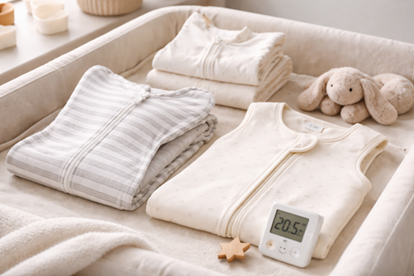
If you've ever stood in front of the cot at bedtime, holding a sleepsuit in one hand and a room thermometer in the other, trying to calculate whether your baby needs 0.5 or 1.0 TOG tonight plus or minus a vest depending on whether you've got the heating on, you are not alone. Baby sleep layers are one of those things that should be simple but somehow feel like a GCSE exam you didn't revise for.
The good news: it's genuinely less complicated than the internet makes it look. Here's a clear, stage-by-stage guide to what goes on your baby and when.
Stage One: The Swaddle Phase (Birth to Around 3-4 Months)
Newborns have what's called the Moro reflex. It's that sudden startle where their arms fly out and they wake themselves up looking absolutely furious about it. If you've watched your baby jolt awake for the fifth time in an hour and wondered what on earth keeps setting them off, this is usually the culprit.
Swaddling helps manage this by keeping their arms gently contained, recreating the snug feeling of the womb. It's not about restricting movement; it's about providing the secure, close environment they've been used to for nine months.
A good swaddle is one that's easy to use at 3am (so, zip-up rather than origami-style wrapping with a muslin square), fits securely around the torso, and still allows healthy hip movement. The hips should be able to flex and move naturally. Some babies prefer their arms tucked down by their sides, but plenty actually settle better with their arms up near their face. It's their natural self-soothing position, and if your baby keeps busting out of a traditional wrap like a tiny escape artist, that's probably why. Work with them, not against them.
You'll know it's time to move on from swaddling when your baby starts showing signs of rolling. Once they're trying to flip, the swaddle needs to go for safety reasons. This usually happens somewhere between three and five months, though every baby has their own timeline.
Stage Two: The Sleeping Bag Phase (From Around 4 Months Onward)
Once you've moved on from the swaddle, baby sleeping bags take over. Think of them as a wearable duvet that can't be kicked off at midnight, pulled over the face, or bunched into a worrying heap in the corner of the cot. They're the safe sleep alternative to loose blankets, and most parents find they become a non-negotiable part of the bedtime routine fairly quickly.
The key thing to understand is TOG ratings. TOG measures how much warmth the fabric retains, and matching it to your room temperature keeps your baby comfortable without the guesswork.
For rooms around 24 degrees Celsius and above, a 0.2 TOG (basically a lightweight cotton layer) is enough. Between 20 and 24 degrees, a 1.0 TOG works well for most babies. Below 20 degrees, you might want a 2.5 TOG, especially in the depths of a British winter when even the radiators seem reluctant.
Layer underneath according to the room temperature too. A short-sleeved bodysuit under a 1.0 TOG bag is the classic combination for an average British bedroom. A long-sleeved bodysuit plus a sleepsuit under a 2.5 TOG for the coldest nights. Resist the temptation to overdress, as hard as that is when it's freezing outside. Babies regulate temperature differently to adults, and overheating is a bigger concern than being slightly cool. If their chest feels warm (not hot or sweaty) and their hands are a normal temperature, you've got it right.
The Transition: Swaddle to Sleeping Bag
This bit worries new parents more than it needs to. Some sleeping bags are designed specifically as transitional products, with detachable arm panels or wings that let you gradually give your baby more freedom of movement. Others simply have open armholes, and you go straight in.
Either approach works. Some babies barely notice the switch, especially if you time it well. Others have a few unsettled nights while they adjust to the new feeling. If your baby has been a happy swaddler, start the transition during a calm period. Avoid sleep regressions, growth spurts, teething episodes, or the week your in-laws visit. You want as few variables as possible.
A helpful trick: keep the rest of the bedtime routine exactly the same. Same bath, same book, same dim lighting. The sleeping bag is the only change. Babies are creatures of habit, and the more familiar everything else feels, the easier the new element goes down.
The Bottom Line
Swaddle first, sleeping bag second, and don't overthink the TOG charts. There are helpful guides on most sleeping bag packaging that spell out exactly which TOG for which temperature, and once you've checked it a few times, it becomes second nature.
Sleep layering is one of those parenting skills that feels intimidating on paper but becomes instinctive within a week or two. You'll be eyeballing the room temperature and reaching for the right bag without thinking about it. You've got this.